
August 18, 2026
Why Turnaround Time Is the Wrong Way to Judge a Dental Lab
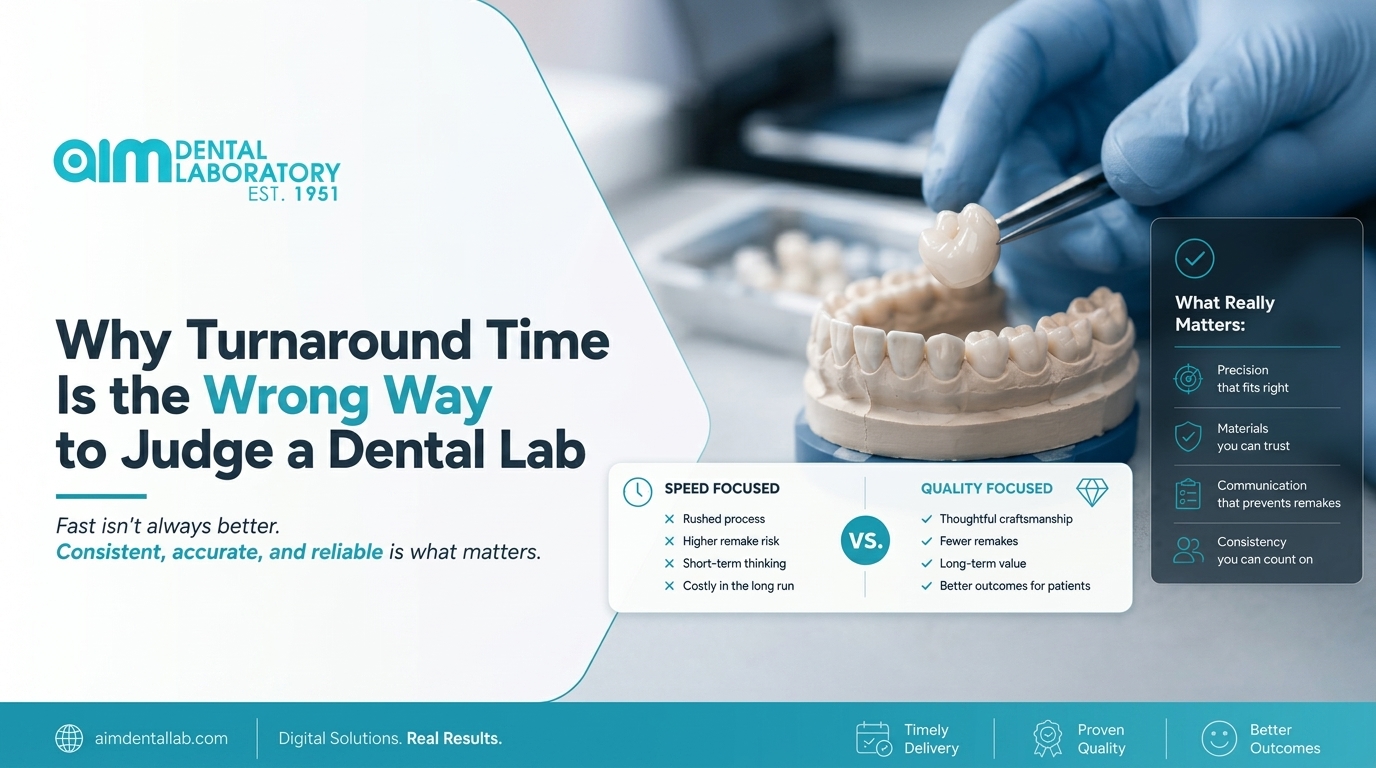
Ask a practice what they like about their lab, and turnaround time comes up almost immediately. It's understandable — it's the easiest thing to measure, the easiest thing to compare, and the number every lab is happy to advertise. Five-day standard. Two-day rush. It sounds like a straightforward way to judge reliability.
It isn't, and treating it like one is how practices end up surprised by a lab they thought they'd already evaluated correctly.
Speed and quality are measured separately, on purpose
Turnaround time answers one question: how long does a case take. It says nothing about whether that case comes back right. A lab can be fast and inconsistent. A lab can be slower and remarkably precise. Those are two different operational strengths, and a single number can't represent both — which means optimizing for one in isolation tells you very little about the other.
This matters because the two numbers pull against each other under pressure. A lab under volume strain has a lever it can pull to protect its turnaround average: move faster through QC, tighten the review process, ship on schedule. The turnaround number stays intact. The thing that quietly erodes is everything turnaround time doesn't measure.
What a fast remake actually means
Here's the pattern worth watching for: a case comes back wrong, and the lab turns the remake around impressively fast. That feels like good service. It's worth asking a different question first — why did the case need a remake at all, and is that happening more often than it should be.
A lab that's fast at fixing mistakes isn't the same as a lab that doesn't make many. The first is a recovery metric. The second is a quality metric. Practices that only track turnaround time often can't tell these two things apart, because both show up as "fast."
The metric that actually predicts reliability
If turnaround time isn't the right anchor, what is? The more useful number is first-case acceptance rate — how often a case seats correctly the first time, without a remake, without an adjustment that shouldn't have been necessary. That number is harder for a lab to advertise, because it requires them to actually track and disclose their own miss rate. It's also the number that predicts what your Tuesday actually looks like far better than a turnaround promise does.
A related question worth asking directly: does turnaround time stay consistent during your lab's busiest weeks, or does it quietly slip? Consistency under volume tells you more about a lab's actual operational discipline than its best-case number ever will.
Why this shows up more in digital workflows, not less
It might seem like digital scanning and CAD/CAM design would make turnaround time a more reliable signal, since so much of the manual variability is gone. In practice, digital workflows can make it easier to move fast without necessarily catching design or margin issues before they ship — the file moves quickly whether or not it's correct. Speed in a digital pipeline isn't evidence of quality any more than speed in an analog one was. It just means the automation is working, not that the outcome is right.
What to actually ask
Instead of leading with "what's your turnaround time," a more revealing set of questions looks like: What percentage of your cases require no adjustment on delivery? How does your QC process change, if at all, during your busiest periods? If a case does come back, is the remake turnaround different from your standard turnaround, and why?
The answers to those questions will tell you far more about whether a lab is actually reliable than any number printed on their pricing sheet.
The reframe
Turnaround time isn't meaningless — a lab that's chronically slow is its own problem. But it's a floor, not a differentiator. Once a lab meets a reasonable turnaround standard, the number that actually separates a good lab from a great one is how rarely you have to think about turnaround at all, because the case simply arrived correct.
That's a harder thing to put on a rate card. It's also the thing worth actually asking about.
Consistent first-case acceptance, not just speed, is the standard AIM Dental Laboratory builds its process around. If you'd like to see what that looks like in practice, reach out any time at aimdentallab.com.
Enjoyed this?